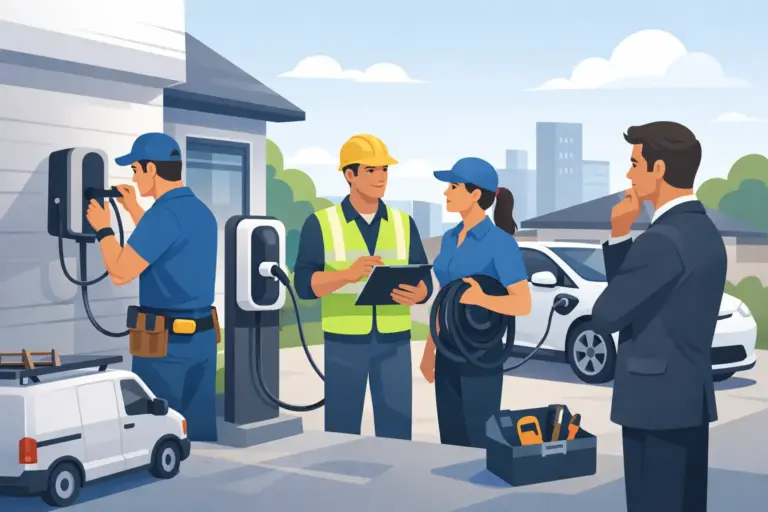


If you are comparing a domestic vs commercial electrician, the difference is not just the type of building they work in. It affects the standards they work to, the scale of the job, the testing involved, the equipment used, and how faults are traced and repaired. Choosing the right electrician matters because a house, a rental property, a shop and a warehouse all place very different demands on an electrical system.
For most customers, the question comes up when they need work done and want to know whether any qualified electrician can take it on. Sometimes the answer is yes. Many experienced contractors work across both sectors. But the right fit depends on the property, the nature of the installation, and whether compliance, downtime or specialist equipment are part of the job.
What is the difference between a domestic vs commercial electrician?
A domestic electrician mainly works in homes and residential settings. That includes houses, flats, extensions, garages, outbuildings and rental properties. The work often involves consumer units, lighting, socket circuits, cooker supplies, showers, fault finding, rewires, EICRs, landlord certificates, EV chargers and, increasingly, solar and battery storage.
A commercial electrician works on premises used for business or public access. That can include offices, shops, salons, schools, restaurants, industrial units, warehouses and communal areas in larger developments. These jobs often involve three-phase supplies, distribution boards, emergency lighting, fire alarm interfaces, maintenance schedules, higher electrical loads and more detailed compliance requirements.
The core principles of safe electrical work are the same in both settings, but the practical reality is different. A family home usually has predictable usage patterns and simpler circuits. A commercial site may have machinery, staff areas, customer-facing spaces, data equipment and strict requirements around access, shutdowns and ongoing operation.
Domestic electrical work is built around daily living
In a home, electrical work tends to focus on safety, convenience and suitability for how the property is used. A domestic electrician needs to understand how people actually live in the space. That means thinking about lighting in kitchens and bathrooms, socket placement, load demands for modern appliances, and whether the installation is safe for families, tenants or buyers.
A lot of domestic work is also reactive. A tripping circuit, old fuse board, damaged socket or failed shower supply needs sorting quickly and with as little disruption as possible. Rewires and consumer unit upgrades also need a clean, organised approach because the work is happening in someone’s home, often while they are still living there.
There is also a strong compliance side in domestic settings, especially for landlords and property sales. EICRs, remedial works and safety certification need to be done properly and explained clearly. Customers rarely want jargon. They want to know what is unsafe, what is recommended, and what needs dealing with now.
Commercial electrical work is built around continuity and compliance
Commercial sites bring a different set of pressures. The electrical system may be supporting staff, customers, stock, security systems, IT infrastructure, refrigeration or plant equipment. That changes the way an electrician approaches both installation and maintenance.
Downtime is often the biggest concern. A fault at home is stressful. A fault in a business can stop trading, affect staff safety or cause financial loss. Because of that, commercial electricians need to plan around working hours, access restrictions and phased shutdowns. The job is not only about getting the electrics right. It is about doing so with minimal disruption.
Commercial installations also tend to involve more complex distribution, larger cable runs, containment systems, emergency lighting, inspection routines and documentation. In some premises, a simple alteration is not simple at all because it interacts with other systems or affects compliance across the wider site.
Training and experience matter more than labels
People often assume there is a strict divide, but in practice many contractors handle both domestic and commercial work. What matters is not the label on its own. It is whether the electrician has the right experience for the job in front of them.
For example, replacing a socket in a small office may not be wildly different from a similar task in a house. On the other hand, a full electrical installation in a retail unit is a different level of planning and responsibility. Likewise, installing solar PV, battery storage or EV charging can sit across both sectors, but each setting has its own design and compliance considerations.
The sensible question is not just, “Are you a domestic or commercial electrician?” It is, “Have you done this type of work before, in this type of property, and can you certify it properly?”
Safety and regulations are not one-size-fits-all
Both domestic and commercial electrical work in the UK must meet current wiring regulations, but the surrounding obligations can differ. In homes, the focus may be on Part P work, EICRs, landlord duties and making sure installations are safe for everyday domestic use.
In commercial premises, there may be broader responsibilities involving employers, building managers, insurers and duty holders. Emergency lighting, periodic inspection, maintenance records and safe isolation procedures may all carry more weight. In shared or public-facing spaces, the consequences of poor electrical work can spread far beyond one occupier.
This is one reason proper testing and certification matter. A qualified electrician should not just complete the work and leave. They should inspect, test and issue the right paperwork where required. That protects the client and confirms the installation is safe and compliant.
Tools, equipment and job planning are often different
A domestic electrician can spend the morning replacing a consumer unit and the afternoon fault finding a kitchen ring circuit. The work still needs care and technical ability, but access is usually straightforward and the environment is familiar.
Commercial work may involve ladders, access equipment, containment systems, out-of-hours scheduling, lock-off procedures and coordination with other trades or site managers. Larger premises can also mean longer fault-finding times because circuits cover more area and feed more equipment.
That does not mean commercial work is always harder, or domestic work is somehow simpler. An old house with years of poor alterations can be every bit as awkward as a business unit. The difference is that the risks, layout and priorities are usually different.
Which electrician do landlords and business owners need?
Landlords often sit between the two categories. A single buy-to-let flat is clearly domestic, but the service they need is often more compliance-led. EICRs, remedial works, smoke and heat alarm upgrades, and quick turnaround between tenancies all require an electrician who understands both safety standards and practical deadlines.
Business owners need someone who can work with the property as it actually functions. A café, office or workshop may not need a large-scale commercial contractor for every job, but it does need an electrician who understands commercial risk, certification and the need to keep the premises operational.
For managed properties, mixed-use buildings and communal areas, experience becomes even more important. Shared supplies, landlord boards, emergency lighting and access arrangements need a contractor who can assess the whole setup rather than just the immediate fault.
How to choose the right electrician for the job
The best starting point is the job itself. If you need a rewire, an EICR, a landlord certificate, emergency fault finding, an EV charger, or a solar and battery installation, ask whether the electrician carries out that work regularly in your type of property.
It also helps to check accreditations and whether the contractor can issue the right certification. NICEIC approval, for example, gives customers added confidence that the work is being carried out to recognised standards. For renewables, the right sector-specific accreditation matters too.
Just as important is how the contractor communicates. You should get clear advice, a sensible explanation of the options, and honest answers about what is necessary now versus what can be planned later. Good electricians do not hide behind technical language. They explain the issue, outline the remedy and carry out the work properly.
For customers across Hull, East Yorkshire and Lincolnshire, that often means choosing a contractor who can handle both domestic and commercial jobs without making either feel like an afterthought. That is where broad experience becomes useful. Steel Electrical Services Ltd works across both sectors, which means homeowners, landlords and business operators can get practical advice based on the actual installation, not a sales script.
Domestic vs commercial electrician – the real answer
The simplest way to look at a domestic vs commercial electrician is this: domestic work supports how people live, while commercial work supports how premises operate. The skills overlap, but the demands are different.
If your property is residential, you need someone who understands home safety, testing, upgrades and tidy, efficient work in lived-in spaces. If your premises are commercial, you need someone who can manage compliance, minimise disruption and work confidently with more complex systems. And if your needs cross both, the strongest choice is often a contractor with proven experience in each.
A good electrician will tell you where the line matters and where it does not. That kind of straight answer usually tells you as much about the contractor as their qualifications do.